I do not know! What does your 'engineers' square indicate?:rolleyes:dusty wrote:Well now, I am really in a pickle.
If I can't get past deciding how much saw blade wobble I can accept, there is no way that I can go on to perform a complete table alignment.
Or is there?
When we determine and mark the high spot on the sanding disk or we color code a specific tooth on the saw blade and that point is used for "the point of reference" during table alignment, that is just what we are doing.
We are ignoring run out.
I trust that you will correct me if I am wrong but there is no where in Shopsmith documentation that the method for measuring runout is detailed.
Furthermore, if one decides to improve run out performance on a particular Mark V, just what can be done. I believe that the only recourse is to change bearings in the quill or replace the quill.
I am ignoring the fact that you could have a bent blade, or improperly installed blade or an excessively worn arbor or saw dust between the blade and arbor - things like that.
Now, that having all been said, I think it is safe to begin doing the table alignment. Besides, my Wixey (attached to the saw blade) reads 0 degrees. Can you get better than that?
Where Does One Begin?
Moderator: admin
-
JPG

- Platinum Member
- Posts: 35600
- Joined: Wed Dec 10, 2008 7:42 pm
- Location: Lexington, Ky (TAMECAT territory)
╔═══╗
╟JPG ╢
╚═══╝
Goldie(Bought New SN 377425)/4" jointer/6" beltsander/12" planer/stripsander/bandsaw/powerstation /Scroll saw/Jig saw /Craftsman 10" ras/Craftsman 6" thicknessplaner/ Dayton10"tablesaw(restoredfromneighborstrashpile)/ Mark VII restoration in 'progress'/ 10E[/size](SN E3779) restoration in progress, a 510 on the back burner and a growing pile of items to be eventually returned to useful life. - aka Red Grange
╟JPG ╢
╚═══╝
Goldie(Bought New SN 377425)/4" jointer/6" beltsander/12" planer/stripsander/bandsaw/powerstation /Scroll saw/Jig saw /Craftsman 10" ras/Craftsman 6" thicknessplaner/ Dayton10"tablesaw(restoredfromneighborstrashpile)/ Mark VII restoration in 'progress'/ 10E[/size](SN E3779) restoration in progress, a 510 on the back burner and a growing pile of items to be eventually returned to useful life. - aka Red Grange
-
dusty

- Platinum Member
- Posts: 21530
- Joined: Wed Nov 22, 2006 6:52 am
- Location: Tucson (Wildcat Country), Arizona
Where Does One Begin?
You are absolutely correct, farmer. One cannot ignore all those simple but possible contributors to an inaccurate cut. Just like one cannot totally ignore run out.
So what must I confirm first in this process.
I know that I have about .003" of run out with the arbor and blade that I normally use and I determined that using a dial indicator.
But there are many amongst us who contend that a dial indicator is NOT a must have tool and that measurements accurate to thousandths of an inch are not necessary in wood working.
OKAY. I buy all of that. Where does one go from here? How can one perform a totally acceptable Mark V alignment without running out to purchase equipment that we have all agreed is not necessary.
So what must I confirm first in this process.
I know that I have about .003" of run out with the arbor and blade that I normally use and I determined that using a dial indicator.
But there are many amongst us who contend that a dial indicator is NOT a must have tool and that measurements accurate to thousandths of an inch are not necessary in wood working.
OKAY. I buy all of that. Where does one go from here? How can one perform a totally acceptable Mark V alignment without running out to purchase equipment that we have all agreed is not necessary.
"Making Sawdust Safely"
Dusty
Sent from my Dell XPS using Firefox.
Dusty
Sent from my Dell XPS using Firefox.
-
robinson46176
- Platinum Member
- Posts: 4182
- Joined: Mon Mar 09, 2009 9:00 pm
- Location: Central Indiana (Shelbyville)
One of the first things I was taught in my first metal shop class (we had just moved up to iron from the bronze age)  (1957) was how to center a piece of 3/4" round aluminum stock in a 4 jaw chuck. We were to reverse the tool holder and run the back end of it up to the stock while turning the chuck by hand (belt loosened). The back of the tool holder was just watched as to clearance and the independent jaws each adjusted to attempt to center the stock. Three weeks later when most of us finally accomplished this we could then start turning.
If I wonder about a Shopsmith I just set the top of the table about a half inch or so below the quill end stub and out maybe an inch away from it. Then I toss a small board (or what ever is handy) on the surface of the table. It is not fastened down. I slide it up against front of the quill stub and turn the arbor by hand watching to see if a gap opens and closes as the stub turns. I can slide it back up against the stub to see where it is high or low. If I cannot see the gap opening and closing I feel that the accuracy is quite "adequate". The small board might be a piece of a 2"x 4" or a 1"x 2" a foot or so long. I like keeping a small faceplate on the outboard end when I can to use as a hand-wheel.
-
I would suspect that the folks that use their SS for a lot of "heavy" faceplate turning that is not supported between centers (like big bowls) are at far more risk of having problems with this kind of wobble. When you get right down to it, that stub is awfully small for some of the loads it is asked to carry. It has to be one really tough piece of steel.
(1957) was how to center a piece of 3/4" round aluminum stock in a 4 jaw chuck. We were to reverse the tool holder and run the back end of it up to the stock while turning the chuck by hand (belt loosened). The back of the tool holder was just watched as to clearance and the independent jaws each adjusted to attempt to center the stock. Three weeks later when most of us finally accomplished this we could then start turning.If I wonder about a Shopsmith I just set the top of the table about a half inch or so below the quill end stub and out maybe an inch away from it. Then I toss a small board (or what ever is handy) on the surface of the table. It is not fastened down. I slide it up against front of the quill stub and turn the arbor by hand watching to see if a gap opens and closes as the stub turns. I can slide it back up against the stub to see where it is high or low. If I cannot see the gap opening and closing I feel that the accuracy is quite "adequate". The small board might be a piece of a 2"x 4" or a 1"x 2" a foot or so long. I like keeping a small faceplate on the outboard end when I can to use as a hand-wheel.
-
I would suspect that the folks that use their SS for a lot of "heavy" faceplate turning that is not supported between centers (like big bowls) are at far more risk of having problems with this kind of wobble. When you get right down to it, that stub is awfully small for some of the loads it is asked to carry. It has to be one really tough piece of steel.
--
farmer
Francis Robinson
I did not equip with Shopsmiths in spite of the setups but because of them.
1 1988 - Mark V 510 (bought new), 4 Poly vee 1 1/8th HP Mark V's, Mark VII, 1 Mark V Mini, 1 Frankensmith, 1 10-ER, 1 Mark V Push-me-Pull-me Drillpress, SS bandsaw, belt sander, jointer, jigsaw, shaper attach, mortising attach, TS-3650 Rigid tablesaw, RAS, 6" long bed jointer, Foley/Belsaw Planer/molder/ripsaw, 1" sander, oscillating spindle/belt sander, Scroll saw, Woodmizer sawmill
farmer
Francis Robinson
I did not equip with Shopsmiths in spite of the setups but because of them.
1 1988 - Mark V 510 (bought new), 4 Poly vee 1 1/8th HP Mark V's, Mark VII, 1 Mark V Mini, 1 Frankensmith, 1 10-ER, 1 Mark V Push-me-Pull-me Drillpress, SS bandsaw, belt sander, jointer, jigsaw, shaper attach, mortising attach, TS-3650 Rigid tablesaw, RAS, 6" long bed jointer, Foley/Belsaw Planer/molder/ripsaw, 1" sander, oscillating spindle/belt sander, Scroll saw, Woodmizer sawmill
-
dusty
- Platinum Member
- Posts: 21530
- Joined: Wed Nov 22, 2006 6:52 am
- Location: Tucson (Wildcat Country), Arizona
robinson46176 wrote:One of the first things I was taught in my first metal shop class (we had just moved up to iron from the bronze age)
If I wonder about a Shopsmith I just set the top of the table about a half inch or so below the quill end stub and out maybe an inch away from it. Then I toss a small board (or what ever is handy) on the surface of the table. It is not fastened down. I slide it up against front of the quill stub and turn the arbor by hand watching to see if a gap opens and closes as the stub turns. I can slide it back up against the stub to see where it is high or low. If I cannot see the gap opening and closing I feel that the accuracy is quite "adequate". The small board might be a piece of a 2"x 4" or a 1"x 2" a foot or so long. I like keeping a small faceplate on the outboard end when I can to use as a hand-wheel.
-
I would suspect that the folks that use their SS for a lot of "heavy" faceplate turning that is not supported between centers (like big bowls) are at far more risk of having problems with this kind of wobble. When you get right down to it, that stub is awfully small for some of the loads it is asked to carry. It has to be one really tough piece of steel.
Absolutely. This method of confirmation works with a great deal of precision. If you can not see the gap deviate in size, the gap is not large enough to worry about. Is it less than .001"? Who cares. It is so small that it is of no consequence.
Perfect example of doing precision work without making a measurement.
When I do what you have described on my Mark V, I can visually detect the deviation but it is so minute that it is of no consequence (at least to me). Keep in mind that I know my run out to be on the order of .003" (with this blade and arbor). I have not measured run out at the end of the drive shaft.
"Making Sawdust Safely"
Dusty
Sent from my Dell XPS using Firefox.
Dusty
Sent from my Dell XPS using Firefox.
-
dusty
- Platinum Member
- Posts: 21530
- Joined: Wed Nov 22, 2006 6:52 am
- Location: Tucson (Wildcat Country), Arizona
Where Does One Begin?
Just can not get rid of those measuring devices.
[ATTACH]5881[/ATTACH]
[ATTACH]5882[/ATTACH]
[ATTACH]5883[/ATTACH]
[ATTACH]5884[/ATTACH]
[ATTACH]5881[/ATTACH]
[ATTACH]5882[/ATTACH]
[ATTACH]5883[/ATTACH]
[ATTACH]5884[/ATTACH]
- Attachments
-
- P9090001.JPG (147.69 KiB) Viewed 7609 times
-
- P9090002.JPG (148.19 KiB) Viewed 7606 times
-
- P9090004.JPG (136.42 KiB) Viewed 7607 times
-
- P9090006.JPG (141.87 KiB) Viewed 7610 times
"Making Sawdust Safely"
Dusty
Sent from my Dell XPS using Firefox.
Dusty
Sent from my Dell XPS using Firefox.
-
JPG
- Platinum Member
- Posts: 35600
- Joined: Wed Dec 10, 2008 7:42 pm
- Location: Lexington, Ky (TAMECAT territory)
Excellent pix Dusty! Cannot help but wonder what those white dots on your miter gauge are.
RE: Wobble - Unless the workpiece is being fed very aggressively the wobble will not make itself known. The 'high' point will skim off material the full length of the cut. If fed too fast, scalloping WILL occur. Solution: feed slow!;)
RE: Wobble - Unless the workpiece is being fed very aggressively the wobble will not make itself known. The 'high' point will skim off material the full length of the cut. If fed too fast, scalloping WILL occur. Solution: feed slow!;)
╔═══╗
╟JPG ╢
╚═══╝
Goldie(Bought New SN 377425)/4" jointer/6" beltsander/12" planer/stripsander/bandsaw/powerstation /Scroll saw/Jig saw /Craftsman 10" ras/Craftsman 6" thicknessplaner/ Dayton10"tablesaw(restoredfromneighborstrashpile)/ Mark VII restoration in 'progress'/ 10E[/size](SN E3779) restoration in progress, a 510 on the back burner and a growing pile of items to be eventually returned to useful life. - aka Red Grange
╟JPG ╢
╚═══╝
Goldie(Bought New SN 377425)/4" jointer/6" beltsander/12" planer/stripsander/bandsaw/powerstation /Scroll saw/Jig saw /Craftsman 10" ras/Craftsman 6" thicknessplaner/ Dayton10"tablesaw(restoredfromneighborstrashpile)/ Mark VII restoration in 'progress'/ 10E[/size](SN E3779) restoration in progress, a 510 on the back burner and a growing pile of items to be eventually returned to useful life. - aka Red Grange
-
dusty
- Platinum Member
- Posts: 21530
- Joined: Wed Nov 22, 2006 6:52 am
- Location: Tucson (Wildcat Country), Arizona
[quote="JPG40504"]Excellent pix Dusty! Cannot help but wonder what those white dots on your miter gauge are.
RE: Wobble - Unless the workpiece is being fed very aggressively the wobble will not make itself known. The 'high' point will skim off material the full length of the cut. If fed too fast, scalloping WILL occur. Solution: feed slow!]
There is not enough wobble on this blade to be a problem (.003").
The white spots are remnants of a errant spray painting session from many years ago. I have not cleaned up from that session as a continuing reminder (to me) that one really should not spray paint in the shop.
Don't judge anything from the ZCI. That ZCI remains on the table all of the time and has been through many changeovers and blade changes. It does speak well of the rubber ring on the tubes.
When I am doing something where I hope for fine results, I change to a "new" insert and cut a fresh ZCI.
Incidently, if you want to measure the effects of blade wobble, just change to a new insert and cut a new ZCI. Measure the kerf that you just cut (in the ZCI) and then measure the width of the blade (two adjacent teeth). The difference between these two numbers is the result of wobble (your run out number).
RE: Wobble - Unless the workpiece is being fed very aggressively the wobble will not make itself known. The 'high' point will skim off material the full length of the cut. If fed too fast, scalloping WILL occur. Solution: feed slow!]
There is not enough wobble on this blade to be a problem (.003").
The white spots are remnants of a errant spray painting session from many years ago. I have not cleaned up from that session as a continuing reminder (to me) that one really should not spray paint in the shop.
Don't judge anything from the ZCI. That ZCI remains on the table all of the time and has been through many changeovers and blade changes. It does speak well of the rubber ring on the tubes.
When I am doing something where I hope for fine results, I change to a "new" insert and cut a fresh ZCI.
Incidently, if you want to measure the effects of blade wobble, just change to a new insert and cut a new ZCI. Measure the kerf that you just cut (in the ZCI) and then measure the width of the blade (two adjacent teeth). The difference between these two numbers is the result of wobble (your run out number).
"Making Sawdust Safely"
Dusty
Sent from my Dell XPS using Firefox.
Dusty
Sent from my Dell XPS using Firefox.
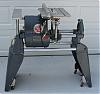
I had one of my dedicated drill presses set up a a milling machine. Any quill wobble/play/whatever was very noticeable over a long cut. I ended up machining the quill housing and shaft to accept a second bearing, behind the front one, that was the same size. This gave me better results comparied to the single front bearing quill.robinson46176 wrote:I would suspect that the folks that use their SS for a lot of "heavy" faceplate turning that is not supported between centers (like big bowls) are at far more risk of having problems with this kind of wobble. When you get right down to it, that stub is awfully small for some of the loads it is asked to carry. It has to be one really tough piece of steel.
Yes, I have a few bent quill shafts laying around. Yes, the quill shaft in front of the front bearing does bend under certain conditions and a double bearing would not have helped prevent this problem. A Speed Reducer may have prevented this problem.
Bill Mayo bill.mayo@verizon.net
Shopsmith owner since 73. Sell, repair and rebuild Shopsmith, Total Shop & Wood Master headstocks, SPTs, attachments, accessories and parts. US Navy 1955-1975 (FTCS/E-8)
Shopsmith owner since 73. Sell, repair and rebuild Shopsmith, Total Shop & Wood Master headstocks, SPTs, attachments, accessories and parts. US Navy 1955-1975 (FTCS/E-8)
And one can use the wobble to perfect the alignment in lieu of trying to find a wobbleless blade/disc.dusty wrote:...it is necessary to ascertain that the blade does not wobble.
A 1/2 dowel clamped tightly to the miter gauge then run thru a cut will provide excellent audio feedback to the positioning of the blade/disc to the dowel at the front relative to the rear as the blade is rotating.
With a blade-- and some would say with any blade-- there will always be wobble, the less so as blade speed increases. I should think one would want the highest speed for the finest measurement, but there may be noise level to noise detection give and take there.
One odd thing about this is that the best results come from your worst cutting blade.